Apr 29 • Cecilia Lynch

5 Signs You're Stuck in Tactical Thinking and What to Do About It

Most professionals don't realize they're stuck in tactical thinking. That's what makes it such an effective trap.

Tactical thinking feels productive. You're solving problems, making decisions, and keeping things moving. From the inside, it looks a lot like good leadership. From the outside and in the long run, it often looks like someone who can't quite get ahead of their own workload.

The five signs below are patterns, not character flaws. They show up in capable, hardworking people across every kind of role and organization. If you recognize yourself in more than one of them, that's useful information — not a verdict.

Sign 1: You solve the same problems over and over

This is the most telling sign of all. If a problem keeps coming back, the same team friction, the same client complaint, the same operational breakdown, it's a signal that you've been treating symptoms rather than causes.


Tactical thinking addresses what's visible. It fixes the thing in front of you and moves on. Strategic thinking asks why this keeps happening and what would need to change at a deeper level to stop it.


The test is simple: think of the three most time-consuming problems in your work right now. How many of them have you dealt with before in some form?


If the answer is most of them, you're not dealing with bad luck. You're dealing with a pattern that tactical responses aren't built to break.


What to do
: The next time a recurring problem surfaces, resist the urge to fix it immediately. Spend ten minutes asking what system or condition keeps producing it. That question alone will point you toward a more durable solution than whatever you were about to do.

Sign 2: Your week is driven by what's loudest, not what matters most

You start Monday with a clear sense of what needs to happen. By Wednesday, you're deep in something that wasn't on the list. By Friday, the important work will have moved to next week, again.

This is urgency addiction in action. It's one of the most common tactical thinking traps, and it's particularly hard to break because urgent things genuinely do need attention. The problem isn't that you respond to urgency. It's that urgency that has become the primary filter for how your time and energy get allocated.

Strategic thinkers still deal with urgent situations. The difference is that urgency doesn't automatically override everything else. They have a clear enough sense of what actually matters and why that they can triage rather than just react.

What to do: At the start of each week, write down the two or three outcomes that would make the week genuinely successful, not just busy. Before taking on anything unplanned, ask whether it's genuinely urgent or just loud. The distinction is often clearer than it feels in the moment.

Sign 3: You watch what competitors or peers are doing and adjust accordingly

Awareness of what others in your space are doing is healthy. Letting that awareness drive your decisions is a different matter.

When a competitor drops their price, launches a new service, or makes a hire you didn't expect, the tactical instinct is to respond in kind. Match the price. Launch something similar. Move faster. The problem is that a strategy defined by what others do is always one step behind. You're not making decisions based on where you want to go, you're making them based on where someone else just went.

This pattern, sometimes called competitor mimicry, is especially common in organizations or roles where visible competitive moves create internal pressure to respond quickly. The response feels necessary. It often isn't.


What to do
: When you notice a competitive move creating pressure to react, ask one question before acting: Does responding advance my own strategy, or does it just reduce my discomfort? If it's the latter, the pressure is tactical. The decision deserves a more strategic frame.

Sign 4: You give people what they ask for, then find out that's not what they needed

This one is subtle, and it tends to show up most in roles where serving others is central, client-facing work, team leadership, and nonprofit service delivery.

Someone makes a request. You fulfill it well. And then it turns out the request wasn't really the issue. The client needed something different. The team member needed support, not a solution. The program participant needed a different kind of help than the one they described.


Tactical thinking takes requests at face value. Strategic thinking asks what's underneath the request, what the person is actually trying to accomplish, what problem they're really trying to solve. That question often reveals a response that's more useful than the one that was asked for.


What to do
: Before fulfilling any significant request, spend a moment asking what outcome the person is actually trying to achieve. Then ask whether what they've requested is the best way to get there. Sometimes it is. Often, this one question surfaces a better answer.

Sign 5: You feel like you're always behind, no matter how much you accomplish

This is the cumulative effect of tactical overload. When your work is primarily reactive, responding to what comes in, solving what breaks, fulfilling what's requested, you can work hard and still feel like you're not making real progress. Because tactically, you're not. You're maintaining, not advancing.

Strategic thinking creates a different relationship with your workload. When you're working on things that genuinely move you forward — building capabilities, addressing root causes, making decisions with longer time horizons — the work feels different. Progress becomes visible in a way it doesn't when you're just keeping up.

The feeling of always being behind is a signal worth paying attention to. It's often less about volume of work and more about the nature of it.

What to do: Look at how you spent your time last week. Divide it roughly into two categories: work that addressed something immediate, and work that invested in something longer-term. If the first category is close to 100%, that ratio is worth changing. Even small shifts of one hour a week of genuinely strategic work compound over time.

What All Five Signs Have in Common

Each of these patterns has the same underlying structure: a default response that feels productive in the short term but limits progress over time. They're not signs of poor judgment. They're signs of a thinking habit that hasn't been updated to match the demands of a more complex role or a more ambitious goal.

Recognizing the pattern is the first step. The second is understanding which pattern is most dominant for you, because the fix looks different depending on where the trap is set.

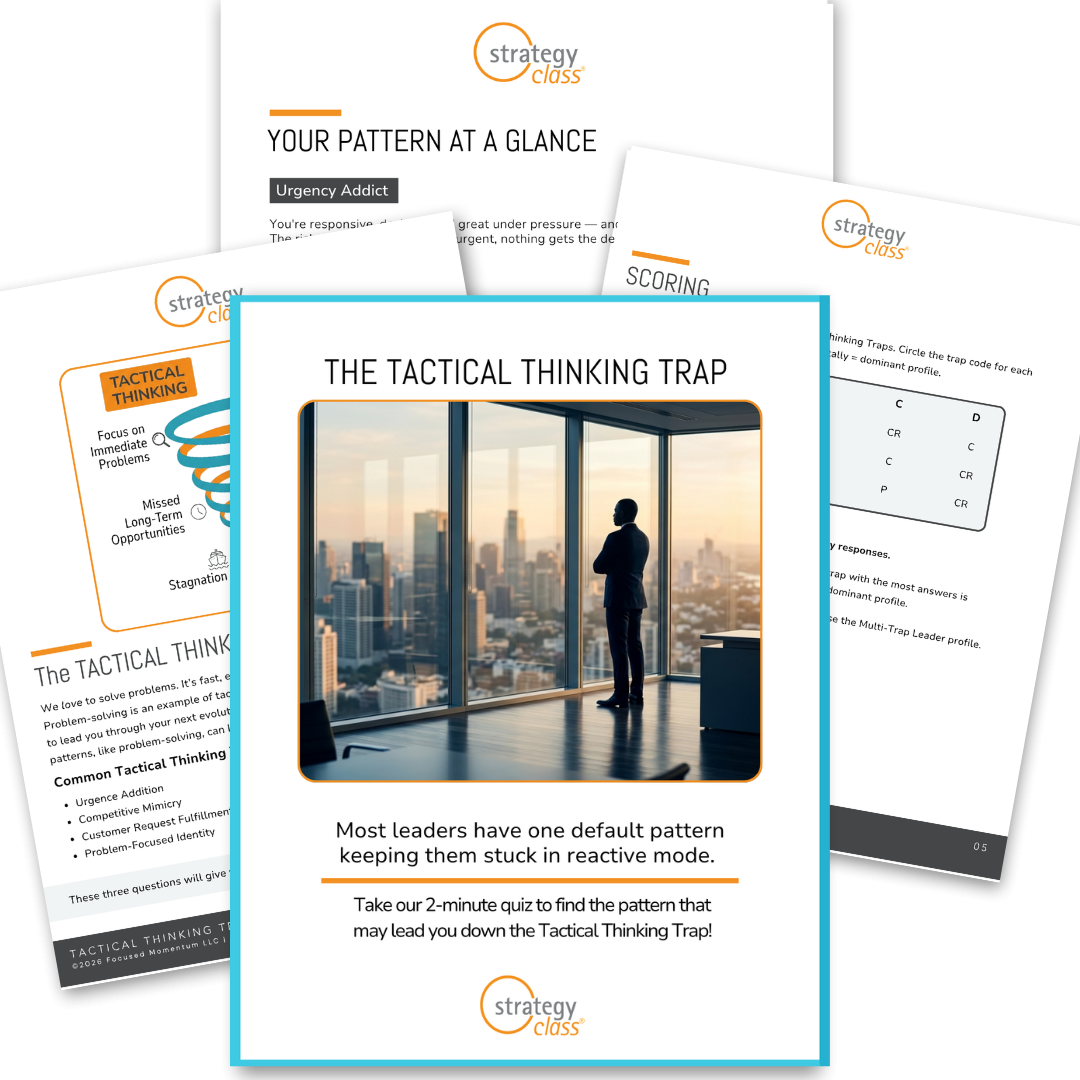
Want to know which tactical thinking pattern is keeping you most stuck?

The Tactical Thinking Trap Quiz identifies your dominant pattern in about two minutes and gives you a clear starting point for breaking it.